

The Real State of AI in the CFO Office
What every CFO needs to know. We read the big reports on AI in finance, checked every number at the source and put them side by side.
Every week another AI report lands in your inbox.
Each one has a headline number. Many of them contradict each other.
We put 30 sources side by side and traced every number back to the report.
Here is what holds up.
In this issue
8 chapters, one per theme. Each one opens with the number that matters and ends with what it means for your finance team. Read it front to back, or jump to the one you need.

59% use AI. 91% saw low or moderate impact.
AI use in finance grew fast for a year and then stalled. Results have not caught up.
In 2023, 37% of finance functions used AI. A year later it was 58%. 21 points in a single year.
Then 2025: 59%. 1 point in a whole year. In Gartner's words, momentum has slowed.
In 2024 Gartner predicted that 90% of finance functions would use at least one AI solution by 2026. A year before that deadline, the measured number is 31 points below it.
And of the teams that do use it, 91 out of 100 saw low or moderate impact at first.
0 of 100 saw low or moderate impact
Every survey counts "using AI" differently
KPMG reports 75% active AI use in finance among companies above $250 million in revenue. Deloitte finds 63% of large finance teams have AI fully deployed. IBM, asking 1,500 CFOs, finds that only 6% of finance organisations run at a transformation-ready level.
The spread tells you more than any single number. "Using AI" can mean a chatbot licence for the team, or a month-end close that runs differently. Our guess: most companies are closer to the chatbot licence.
The Dutch picture. In KPMG's survey, 38% of Dutch finance departments used AI and 17% had generative AI in place, behind the US and China. Among 100 Dutch CFOs, about 9 in 10 say AI supports at most a quarter of their strategic decisions.
The question to ask your team: what changed in your numbers because of AI?

63% deployed it. 21% can show the money.
The gap between having AI and earning back what it cost runs through this whole report.
Deloitte asked 1,326 finance leaders at companies above $1 billion. 63% have AI fully deployed and in active use.
Only 21% have it deployed and already see clear, measurable value.
And 14% got that far and also put AI agents to work inside the finance function.
BCG asked about the return. A typical finance team gets 10% ROI from AI, against the 20% many of them are aiming for.
One likely reason: much of the money goes to doing the same work faster. 45% of CFOs say their AI investments lean toward productivity, 20% toward better decisions.
And the bets are small. 47% put just 1% to 5% of their finance technology budget into AI.
What CFOs say their AI money is for
0%
spend 1% to 5% of it on AI
71%
of finance leaders say AI meets or beats their ROI expectations
KPMG's 2026 survey of 1,013 finance leaders sounds a lot happier. Read it next to the others: these are self-reported results against the teams' own expectations, and KPMG also sells AI assurance.
95%
"of organisations are getting zero return" from generative AI
The MIT NANDA report behind it rests on interviews with 52 organisations, 153 survey responses and a review of 300+ public AI initiatives, calls itself preliminary and is not about finance. Worth hearing as a signal, but too thin for your board deck.
The Dutch picture. More than 80% of Dutch organisations plan to spend less than a quarter of their technology and digital budget on AI, according to Deloitte's autumn 2025 survey of 100 CFOs.
Treat AI like any other investment: one business problem, one number to move, one owner. As Gartner puts it about CFOs: "They must not mistake activity for impact."
AI runs on numbers your team still checks by hand
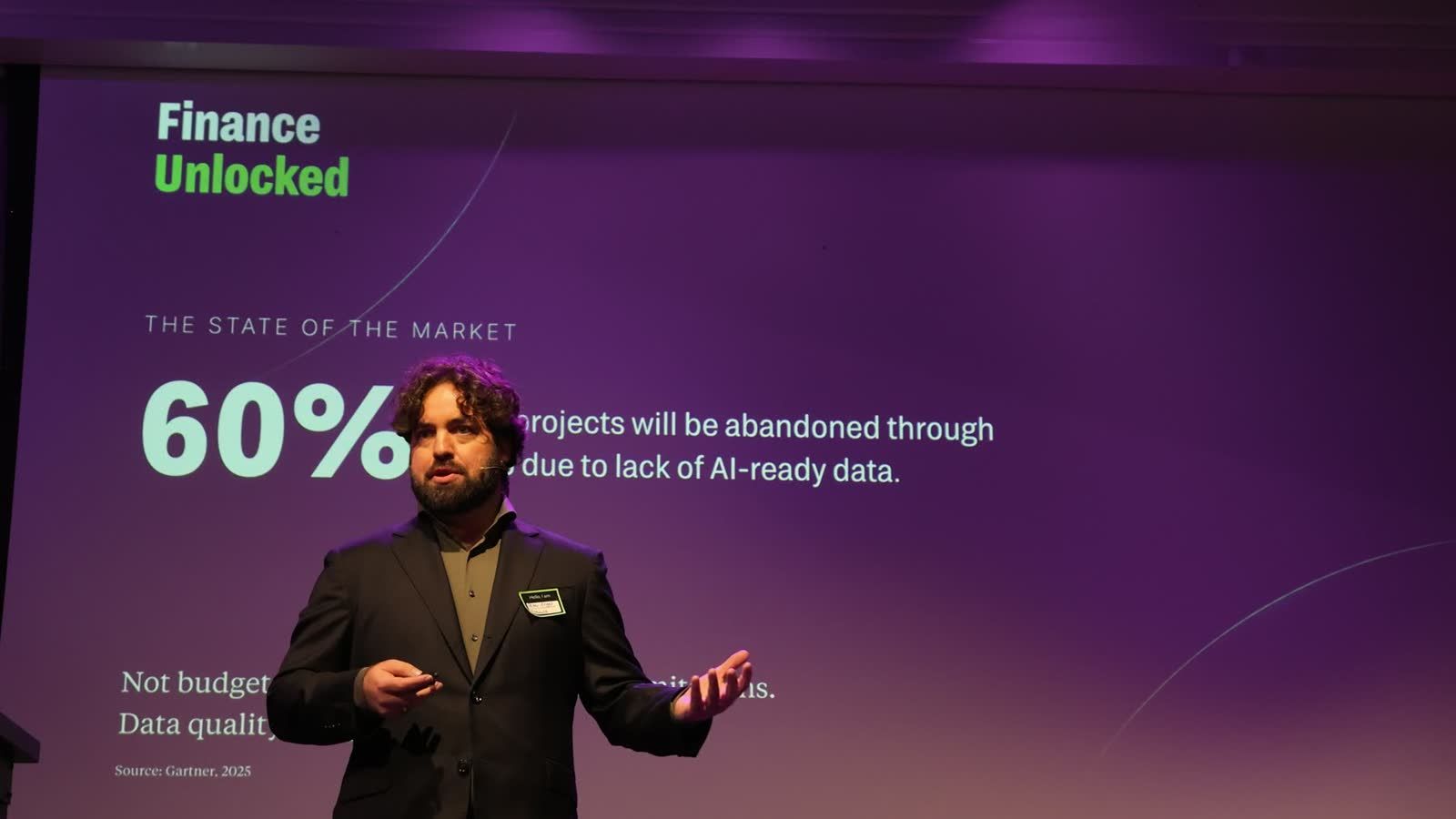
At Finance Unlocked in September, Actuals founder Peter Engel put one Gartner prediction on the screen: through 2026, companies will abandon 60% of AI projects that lack AI-ready data. Several reports in this issue point the same way.
A large company runs its money through 12 payment providers on average: 6 for pay-ins, 6 for payouts. Plus more than 40 bank accounts.
Every one of them settles in its own format, with its own fees, refunds and chargebacks. Treasury teams spend more than 20% of their time on pay-ins and payouts alone.
FP&A teams spend 46% of their time collecting and validating data. And 45% still plan mainly in spreadsheets.
So when CFOs try to fund AI, data is a common hurdle: 61% name data quality as a problem.
Only 11% of executives in finance, risk and sustainability believe their data is good enough for AI.
0%of FP&A time goes to collecting and checking data
0%still plan mainly in spreadsheets
0%
of 1,610 CFOs name data quality as a hurdle for AI investment
Gartner's warning is about the data
Gartner expects companies to abandon 60% of AI projects that are not supported by AI-ready data, through 2026. In the same study, 63% of organisations either lack the right data management practices for AI or are not sure they have them.
For a high-volume business, the problem starts before the ERP. Payouts arrive net of fees, refunds land weeks later, a chargeback reverses a sale from last quarter. If that layer is not reconciled at the source, every AI tool on top of it works with numbers nobody would sign off on.
Fix the transaction layer under your ERP first, and every AI use case after it gets cheaper and safer.
The boring work pays back first
Invoices, matching, reports. The least exciting use cases are the ones with proof behind them.
Finance teams use AI most for knowledge management (49%), accounts payable automation (37%) and error and anomaly detection (34%).
The quick wins pay back fast. Data extraction, AP and AR automation and report creation return their investment within 9 to 10 months.
The hardest evidence comes from a field study by Stanford and MIT. In data from 79 small and mid-sized firms, those that used AI closed the month 7.5 days sooner.
On forecasting, the experts disagree. BCG ranks it near the top for ROI. Gartner ranks forecasting and insight generation among the weakest use cases.
Gartner expects AI inside cloud ERP to make the close 30% faster by 2028. Note the word: expects.
Months until data extraction, AP/AR automation and report creation pay back
0
days sooner monthly close
"ranks close behind" risk management, the highest-ROI use case
▲among the lowest-rated finance AI use cases
▼0%
faster financial close by 2028, Gartner predicts
Start where the work is repetitive, the rules are clear and the volume is high. That is where AI has a track record, and where it frees up the people you need for the harder questions.
Where to start with AI, and where not yet
Not sure where AI belongs in your finance team? Put every idea on the same three scales: what it returns, what it takes, and what can go wrong. This map is our reading of the evidence in this report. Click any bubble to see why it sits there.
Do now
- Automate invoice capture and APThe clearest payback in the data: 9 to 10 months.
- Reconcile payments before they hit the ERPPSP payouts, fees, refunds and chargebacks matched at the source. It is the base under every other use case.
- Put anomaly detection on high-volume flowsOne of the three most used cases, and BCG ranks risk management highest for ROI.
- Match incoming cash in ARAnother 9-to-10-month quick win, once your payment data is reconciled.
Not yet
- Autonomous agents on data you don't trustGartner expects more than 40% of agentic AI projects to be cancelled by the end of 2027.
- AI-written numbers straight to the board26% have already seen AI errors reach the board or the outside world.
- Forecasting on unreconciled actualsA forecast is only as good as the actuals underneath. Even the experts disagree on its ROI.
- Consumer credit decisions without an AI Act planHigh-risk obligations for creditworthiness checks on individuals apply from 2 December 2027.

Half of large-company CFOs plan for agents. 14% have them working with clear value.
AI agents are on the 2026 list of more than half of CFOs at large North American companies. The track record of autonomous finance promises says: slow down and check the data first.
54% of CFOs at North American companies with $1bn or more in revenue say integrating AI agents into finance is a transformation priority for 2026.
KPMG asked where large finance teams stand. 97% of large finance teams say they have started with agents, and 12% say they already run multi-agent systems. All self-reported.
Deloitte's stricter test: AI fully deployed, clear value already delivered, and agents integrated. 14% pass.
Gartner expects more than 40% of agentic AI projects to be cancelled by the end of 2027, because of costs, unclear value or weak risk controls.
We have been here before. In 2022, 55% of finance functions aimed for a touchless close by 2025. In 2026, 63% of finance leaders said AI in 2025 went slower than expected.
0% call agents a 2026 priority
0 of 100 have agents working, with clear value
Over 4 in 10 agentic AI projects expected to be cancelled by end of 2027
aimed for a touchless close by 2025
said AI went slower than expected
An agent acts on whatever data it is given, at machine speed. Give it a ledger you would sign off on, one clear task and a person who reviews the exceptions.

Your team sets the pace more than your tools do
The barrier that keeps coming up is skills. Meanwhile the CFO's own job is changing too.
ACCA asked 1,600 finance professionals about their generative AI skills. 38% call them basic. 34% have no experience at all.
Gartner's newest research points the same way: its analysts call low AI literacy the biggest barrier finance leaders must address. And acquiring and developing AI and digital talent is CFOs' number one near-term challenge.
Meanwhile the CFO job is growing. 62% of CFOs have taken on enterprise technology or AI strategy leadership.
Jobs? Gartner predicted fewer than 10% of finance functions would cut headcount because of AI. It also expects 20% of finance teams to stop hiring people who are not digitally literate by 2028.
0% of CFOs now lead tech or AI strategy
of finance functions cut headcount because of AI
stop hiring people who are not digitally literate
Long before AI changes the size of the finance team, it changes what the team does all day. Budget for training the way you budget for software.

1 in 4 have seen AI errors reach the board or beyond
AI makes mistakes with confidence. In finance, a confident mistake can end up in a board pack, an audit file or a filing.
26% of executives say internal audits have found AI errors that reached external audiences or board members.
Accuracy is now a top worry. 48% of finance leaders name the accuracy of AI-generated financial output as a top concern.
Yet only 29% formally track where their AI adoption fails.
It already cost money. In October 2025, Deloitte refunded part of a A$440,000 report for the Australian government after it was found to contain made-up references. The refund: just over A$97,000.
0% saw AI errors reach the board or outside world
0% formally track where AI adoption fails
The EU AI Act timeline for finance
AI literacy becomes a duty
Companies that use AI must take measures to support their staff's AI literacy. The 2026 Digital Omnibus kept the duty, without a required level.
Rules for general-purpose AI
Obligations for the providers of models like the ones behind ChatGPT and Copilot started to apply.
COSO publishes AI controls
COSO's guidance on internal control over generative AI: govern, inventory, assess, design, implement, monitor. It is not law. Expect your auditor to use it as a frame.
High-risk AI obligations apply
Moved from August 2026 by the Digital Omnibus. Credit scoring of individuals is high-risk. Fraud detection is not.
AI in regulated products
The last group of high-risk obligations, for AI built into products covered by EU safety law.
Treat AI output like the work of a new junior: logged, reviewed and traceable to the source. If you cannot trace a number back to the transaction, neither can your auditor.
What every CFO needs to know
Where do you stand?
Answer the five questions
Each yes moves the needle. The result tells you which part of the map in chapter 05 fits your team today.
AI is only as reliable as the numbers underneath
Curious where your transaction data stands before you put AI on top of it? The high-volume accounting scan shows you in a few minutes.
Sources & method
We used the publisher's own report or press release for every number and checked it there, except where a source is a news report or summary (the Deloitte Australia refund via CFO Dive, the COSO guidance via Deloitte). Most of these are surveys in which people report on their own organisation. Predictions are labelled as predictions, and vendor-sponsored surveys as vendor surveys. Samples differ per study, so we do not add percentages from different reports together. Respondent totals across all surveys are counted once per study.
| Publisher | Report | Date | Sample |
|---|