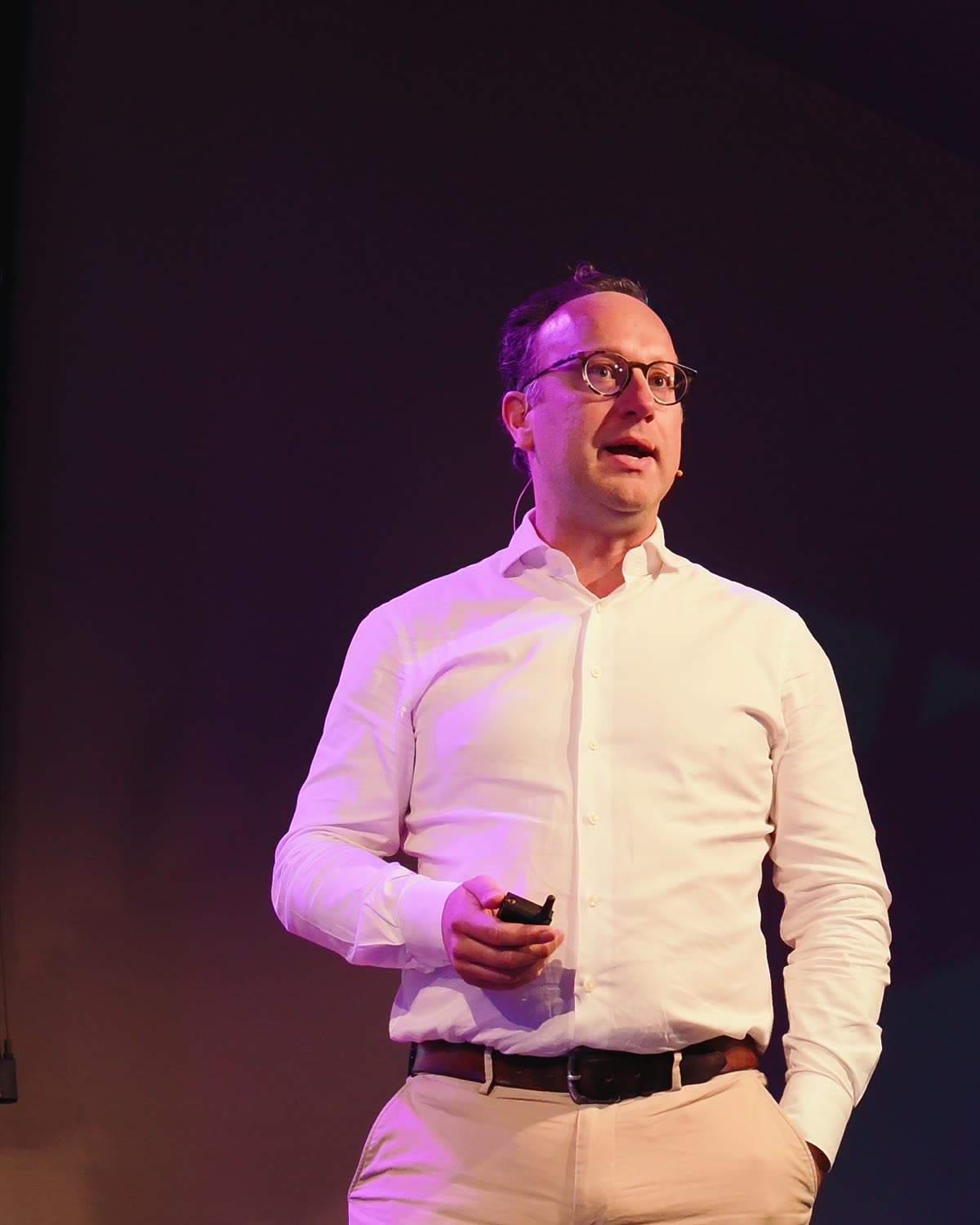

In the 5 days before his keynote at Finance Unlocked, Ronald Kemmeren rang a lot of people for a short interview. His question was simple: what are you doing with AI?
One of them told him how a CFO brought AI into the finance team. The CFO got everyone in a room and said:
Okay, you all have co-pilot now, Microsoft co-pilot. We have AI. I wish you all good luck.
After that, nothing happened. His main takeaway from the calls: this market really moves at 2 speeds. Some companies have figured it out, and a few of them were in the room. At those companies everyone uses AI, and people build their own agents. Others are closer to that CFO.
Ronald is co-founder and partner of Smile Sail, an investment fund for software and AI companies. The main hurdle he sees has little to do with all the cool things AI can suddenly do. It is getting an organisation from no AI to at least some AI, and then scaling from there.
His own team went through exactly that this year, including a stretch where they dropped AI altogether. This article follows his keynote and the questions he answered afterwards.
Everyone on their own island
Before the AI summit, Smile Sail surveyed the tech teams of its portfolio companies to see where they stood. The first finding: everyone is aware of AI and wants to do something with it, but adoption varies a lot. That is not just true of software developers, Ronald stressed.
Said at Finance Unlocked
Individuals are figuring it out on their own little island, and it's hard to scale the individual approach to a team and then to a company.
People need some help there, he said. Leadership has to take the next step and lift adoption from the individual to the company level.
Speeds differ at every level. One person moves faster than another, one team outpaces the next, and the software team may move at a different speed than finance. "I bet you also see these trends within your businesses," he told the room.
Interactive
From islands to the whole company
Click each step to see what Ronald said and what the research says.
Said in the session · Ronald Kemmeren
Everyone on their own island
Individuals figure AI out on their own little island, and that is hard to scale. Leadership has to lift adoption from the individual to the company.
What the research says
Microsoft's 2024 Work Trend Index (31,000 people in 31 countries) found that 78% of AI users bring their own AI tools to work, rising to 80% at small and medium-sized companies.
MicrosoftMIT NANDA's 2025 study found that only 40% of companies had bought an official LLM subscription, while workers at over 90% of surveyed companies regularly used personal AI tools for work.
MIT NANDA
Said in the session · Ronald Kemmeren
When it gets busy, AI drops
In May Ronald's own team got busy, fell back into old habits and stopped using AI.
What the research says
Microsoft's 2024 Work Trend Index found that only 39% of people who use AI at work had received AI training from their company.
Microsoft
Said in the session · Ronald Kemmeren
Train together, build together
In June and July the team trained together and built its own agents in pairs. Use went up again.
What the research says
BCG's 2025 AI at Work survey found that regular AI use is sharply higher among employees who get at least 5 hours of training and access to in-person training and coaching.
BCGBCG's 2026 AI at Work survey (11,749 workers in 14 markets) found that only 36% of respondents feel they have received adequate upskilling, while 72% say skill expectations have shifted.
BCG
Said in the session · Ronald Kemmeren
A CEO topic, with champions
Make AI a CEO topic. Pick 1 AI champion at C-level. Champions in each team can grow bottom-up.
What the research says
McKinsey's State of AI report of March 2025 (1,491 respondents) found that CEO oversight of AI governance is one of the elements most correlated with higher self-reported bottom-line impact from gen AI, yet only 28% report that their CEO oversees AI governance.
McKinseyBCG's 2025 research on AI adoption found that 69% of employees rank peer-to-peer learning among their top 3 ways to build AI skills, and names 'AI champions' as the visible trailblazers of adoption.
BCG
Said in the session · Ronald Kemmeren
Make building fun
Hold a hackathon. How people build matters more than what they make.
Said in the session · Ronald Kemmeren
Count the 10 times
Don't judge an agent by the first time you build it. Think about the 10 times you do the task.
Said in the session · Ronald Kemmeren
Your team owns the outcome
AI can produce endless output, and reviewing it is where people struggle. Make sure people own what they send you.
What the research says
McKinsey's State of AI report of March 2025 found that only 27% of organisations using gen AI have employees review all AI-generated content before it is used.
McKinseyThe UK Financial Reporting Council's 2026 guidance on generative and agentic AI in audit states that the human auditor is always accountable.
FRCIESBA, the global ethics standard-setter for accountants, states that professional responsibility cannot be delegated to a machine and that relying on opaque or unexplained outputs is not acceptable (2026).
IESBA
Said in the session · Ronald Kemmeren
The vendor test: the same request, 3 AI models
Ronald showed a test by a vendor. The same request went to 3 different AI models. The specialised data tool scored 85 percent, against 25 and 50 percent for the others. Even then, he said, your team still needs to own the outcome.
25 percent
50 percent
85 percent
What benchmarks show about AI on business data
On the Spider 2.0 benchmark of 632 real enterprise text-to-SQL problems, GPT-4o solved 10.1% of tasks (versus 86.6% on the simpler Spider 1.0) and o1-preview 17.1%.
Spider 2.0A 2023 data.world benchmark on an enterprise insurance database found that GPT-4 answered 16% of questions correctly directly on SQL, rising to 54% when a knowledge graph was added.
data.world
Example
Example: when does an agent pay for itself?
Example with made-up starting numbers. Fill in your own.
The month his team got too busy for AI
Ronald showed how his own team took to Claude Cowork, which they use to create things with AI. For the first 2 months, he admitted, they were a bit paralysed. People tried different tools on private logins paid by credit card. There were no company accounts. In early April they got started with a few.
Then came May. The team got busy, and people fell back into their old habits.
Because we were so busy, we stopped using AI.
He called it counterintuitive. You would think that the busier you are, the more you can automate.
June and July turned it around. The team started training together, and in groups of 2 they built their own little agents. One reviews non-disclosure agreements: they get a lot of them, and it's a repetitive task. That one worked well. Another takes a reference call, transcribes it, summarises it and turns it into a slide. Not everyone does that every day, but it comes up often, and now they can present the outcomes faster.
Not everything worked. An agent meant to register office visitors and alert reception didn't work out. He was fine with that. People will build some things that work and some that don't. His advice: start experimenting, and reward people for it.
In August and September use stayed high. His slides sum it up: Claude Cowork usage stepped up in late June and has held since, with 90% of output in slides, code, documents and spreadsheets. The team builds slides and makes reports and models in Excel. It also writes a bit of its own code, with no software developers on the team. They are investors, after all.
What could they do better? So far they have only a few agents the whole team can use, such as their PowerPoint skills. They need more team skills, to move from the individual to the company level. Agents that work together on one workflow are still some way off for them.
How they got going
After the talk, the host asked how it started. Was it a memo, or a meeting where someone said: we are starting? Ronald's answer began with an admission. Smile Sail wants to invest in AI companies and believes it is something of a front runner on AI knowledge. Then Claude Code turned out to be a few steps ahead of them. They saw it coming, just not that fast, and they were paralysed too.
At first everyone worked it out alone, with their own accounts. Then they realised everyone had the same frustration. So they said: let's do this together as a team. With the same vision and sense of urgency, they did training sessions together and swapped best practices.
Set direction, build momentum, scale up
Drawing on talks with Smile Sail's portfolio companies and others in the market, Ronald walked through what helps. It starts with setting direction, then building momentum, and then scaling up.
Setting direction is a CEO topic. Share the vision at your stand-up or monthly meeting, however you run it. Create a sense of urgency: this is the new normal.
The second thing he sees working well is champions. Pick 1 person as the company's AI champion, typically at C-level if you ask him. Set aside time for the role, because there is a lot to figure out. All questions about AI and AI strategy go to this person, who drives adoption.
Each team also has an AI champion. Those can grow bottom-up, so you don't have to appoint anyone. See who wants to join in, and make those people feel important.
Then there are guidelines. Some policies are needed to help people build momentum, Ronald said. Earlier in his talk he gave an example close to finance. Your team uses payroll data with AI. One person logs in with a personal account, and suddenly someone else searching for a name finds pay slips. Things like that are already happening. One of the guidelines on his slides: log on to AI tools with your company account, never a personal one. Think about security and privacy when you build your own apps.
Make the build fun
Experimentation comes before building. Some people built an agent to order toilet paper when it ran out. Useless, in a way. What matters to Ronald is how people build, more than what.
So make the build fun. Hold an AI hackathon, as Smile Sail did in Ghent with all its companies, and get bottom-up experimentation going. Share successes and quick wins along the way.
In Ghent, Smile Sail brought together 80 software engineers from its portfolio for 2 days on AI-native engineering. Ronald saw adoption start in engineering, so that is where they began. Everyone was fairly humble, he said, and open to learning from each other. They are all figuring this out at the same time.

From islands to the whole company
The third step lifts AI from individual use to team and company performance. Teams have to work together around it. He gave the example of Harmony, a Smile Sail portfolio company that sells software to banks, insurers and leasing firms. It had a problem: too many sales. It grew too fast and couldn't deliver.
The team came together and worked it out with AI. Sales conversations are now recorded better, delivery teams are involved, everyone works with the same data, and demos get pre-configured. Different parts of the company now share the same data sources and the same small AI process.
Measure usage as well. The companies he spoke to measure both their top 10 and their bottom 10 users. Why talk to the top 10? Because this is about keeping the company together. You want everyone moving at roughly the same speed, and to learn from what goes well so you can repeat it elsewhere.
The last step is measuring business impact. You can't get around it, but it really comes last. Earlier he noted that people feel the urge to measure real business results, but no one has worked out how yet.
Under all of it sits your data. He borrowed a line from earlier that day: garbage in, garbage out. The fundamentals have to be right, and only then can you start building.
Count the 10 times
AI is also moving into the systems finance already works in. Ronald showed NetSuite Next, which adds AI to the NetSuite ERP. Many ERPs are experimenting with this, he noted. You can chat with your ERP about outstanding invoices and how old they are. You get to dashboards nobody set up in advance, without bothering colleagues.
You can also build small agents inside the ERP itself. He showed 15 examples, such as an accrual estimator. Collection agents come up a lot. AI helps you decide where to collect money first, and spots trends and risks. Add signals on credit risk, and people in other teams know whom to chase.
The list itself mattered less to him than your own process. Where does your team spend a lot of time, and what is really repetitive? Then do the sum his way.
Don't consider the first time you need to build an agent, but think about the 10 times you do something, and what is then the time saving or money saving you may have.
If you build it yourself, think about who will maintain it. The first steps are usually easy. When exceptions arise, someone has to handle them and take ownership. That includes the day the person who built your little agent leaves the company.
Your team owns what AI produces
Whether it's code or financial dashboards, there is no longer any limit to how much content AI can produce. Reviewing it, and judging its quality and usefulness, is where people really struggle. Some try to build agents for that, but they haven't cracked it yet.
One AI guideline on his slides was his favourite, because many people in the room already feel that pain. Make sure your team owns the outcome, whatever report they present to you. Someone at lunch put it nicely, he said:
I get double the content, half the insights.
So make sure people own what they send you, and make that a real company value.
Near the end of his talk, Ronald showed a test that makes the same point. Genie is a tool that lets the business talk directly to its data. In a 22-minute video, its maker sent exactly the same request to 3 different LLMs. The other models scored 25 and 50 percent accuracy, and took 7 to 24 minutes to produce an output.
Genie still took 8 minutes, but it reached 85 percent. He liked that the maker published that number itself.
It shows that you and your team still need to own the outcomes. So the human remains in the loop, and the human is just amplified by AI.
One step at a time
The host's last question was where Ronald will be in 5 years. Honestly, he said, he doesn't know. In January his team invited 7 people from McKinsey, who showed a map of the AI landscape full of logos. Ronald raised his hand: he thought Claude was missing, because it started out more B2B and works with connectors. 7 weeks later, Claude Code and Cowork were announced.
So perhaps they had a 7-week information advantage, while Smile Sail invests over 5-year periods. The world is changing so fast that it's hard to predict. Smile Sail takes it one step at a time.
What to do on Monday
Each step below is advice Ronald gave in his keynote.
- Make AI a CEO topic. Share the vision at your stand-up or monthly meeting, and make it urgent: this is the new normal.
- Name 1 AI champion for the company, typically at C-level, and reserve time for the role. Let champions in each team grow bottom-up: see who wants to join.
- Think about security and privacy before your team puts data such as payroll into AI tools.
- Train together and let people build small agents, in groups of 2. Reward experimenting, even when an agent doesn't work out.
- Hold an AI hackathon to make building fun.
- Find work that takes your team a lot of time and is really repetitive. Count the saving over the 10 times you do it, not the effort of the first build.
- Before you build something yourself, decide who will maintain it, including after the builder leaves.
- Measure usage, and talk to both your top 10 and your bottom 10 users. Measure business impact as the last step.
- Get your data fundamentals right before you start building.
- Make ownership a company value: people own what they send you.