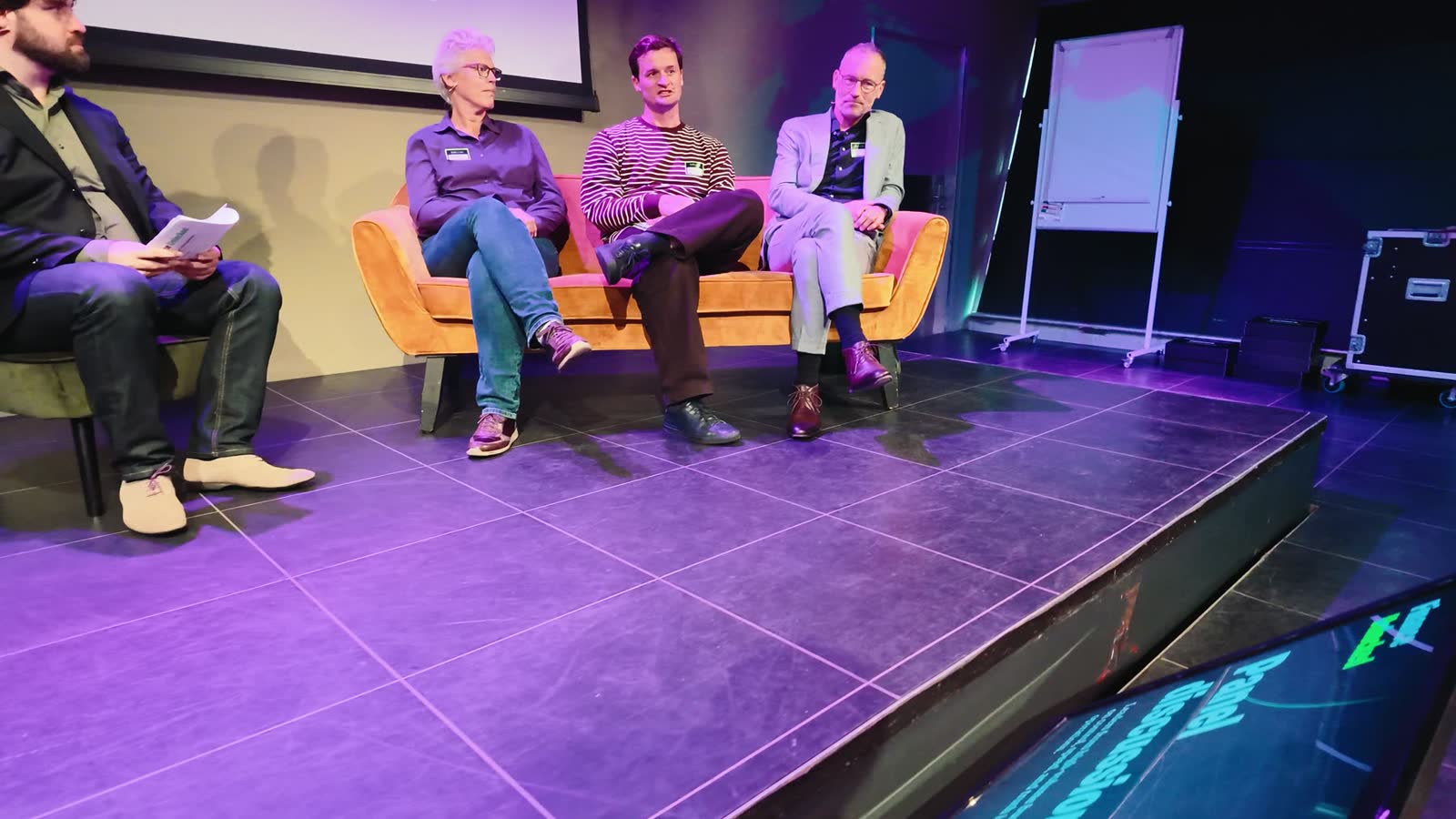

How hard is it to reach the ideal world? In that world, finance has access to all the data and all the accounting, and can act on it in operations. Peter Engel, CEO of Actuals, opened the Finance Unlocked panel with that question.
He had talked to each panellist before, one on one, in the high-volume accounting live series Actuals hosts on LinkedIn. This time he had all 3 of them on stage, to put the discussion points on the table.
Patrick Roozeman is CEO of MultiTankcard. His company runs the transaction processing for about 700,000 users in the Netherlands, for anything to do with fossil fuel or electric charging.
Uwe van Rensburg is CFO of Goboony and Yescapa, 2 companies being merged into one. Each has its own tech platform for bookings, order management and the link with the payment provider. Together they run a 2-sided platform: a marketplace.
Marinda van Harskamp is the founder of Hudifine, a name that stands for human digital finance. She has always worked in finance operations and ERP, and she is a certified coach. Her company designs the financial backbone before you go into an ERP, "or you just get lost in your data".
Start with the business event
Marinda answered first. Her whole family is in accounting, she said, yet for her it all starts with the business. In her financial architecture, the business events come first, and the design starts from there.
So, what is the financial meaning that an event has?
Once you have designed the financial meaning of each event, you can extract the data you need for accounting, tax, AI or ESG. You then know what is in your data, from left to right and back again. That is your data lineage. Her aim is a route from the different events all the way to your data warehouse and your dashboards.
Later in the panel she came back to it. Business events carry a number. You want that number in your financial reporting, and also in your dashboards, your KPIs and your business control. So you have 2 starting points: the business events, and the data you want to see.
She compared it to drilling a tunnel in Switzerland. You start at both ends, the business event and the data you want to see, and then you decide the middle. Her example: a customer charges an electric car. What data do you get from that event? "And then of course your volume goes times a lot," she said.
4 charges a week, 1 fill-up
For Patrick, keeping things aligned goes beyond his own company. His company works in a chain. Customers want to charge their car or fill up their tank with petrol. Suppliers want to be paid. His company sits in the middle and has to keep all of that aligned, inside its own organisation and with the others in the chain.
And the market keeps moving, he said: "the data definition you have today might be different tomorrow."
Electric charging shows how. It is shifting from weekly or monthly files to real time, for a single transaction. And the volume is 4 times higher. On average you charge with your card 4 times a week. With fossil fuel, you fill up about once a week. Your systems have to adapt to that scale as standard.
Asked what he would do differently, Patrick said he hoped the organisation had learned from the mistakes of the past 10 years. He would also take more charge of what comes in and what goes out, instead of letting suppliers and customers set the expectations.
His company has rebuilt how it handles electric charging and the process around it, next to its fossil fuel business. That creates its own problems. The new system has to be integrated with the old one, and at some point the data from both has to come together. Fossil fuel has no future for them, so it keeps running as a business in wind-down, for as long as it is needed.
Charging has a totally different dynamic. There is legislation, VAT and the differences by country. There is home charging versus public charging, and business charging. And there are solar panels and vehicle to grid, when the car becomes a battery for your household. "We need all of that data."
Link each amount to its transaction
Patrick's company tracks the start of each transaction, and at the end there is invoicing, credit and debit. He wants to relate each credit and debit invoice to its origin: this 10 euros comes from exactly this transaction, and that 10 euros from another one.
Get that process right, continuously, and you can start to rely on the outcome in your financial reporting. Your monthly or annual report then shows the exceptions. Focus on the differences you did not expect, he said, and shape the business so that the financial report is just another view on it.
Peter Engel called that a change in mindset. Finance is there to be in control from the side of business operations, he said, and closing the books is only part of it. Patrick put it in one line.
Finance is about at the beginning of the process, rather than the end.
Today, he said, finance scrapes all the data together at the end of the month and puts it in the financial reporting. On the way, it makes up for all the mistakes made earlier in the process. He wants to turn that around. His question: how do you stay in control of the company's financial wellbeing, and what does that mean for the process that comes before?
Interactive
From business event to report
Click each step to see what Patrick, Uwe and Marinda said on the panel, and what the sources say.
Said in the session · Marinda van Harskamp
Start with the business event
Marinda starts with the business events and asks what each one means financially. From there you can extract the data you need: accounting, tax, AI or ESG.
What the sources say
Martin Fowler (2005) describes linking each accounting entry to the domain event that caused it, so you can trace from the event to its financial consequences.
martinfowler.comMartin Fowler (2005) notes that an account is itself an example of event sourcing: its entries are a log of every event that changed its value.
martinfowler.com
Said in the session · Marinda van Harskamp
Decide both ends, then the middle
Marinda compared it to drilling a tunnel in Switzerland. You start at the event and at your reporting, dashboards and KPIs, and then you decide the middle.
Said in the session · Patrick Roozeman
Link each amount to its transaction
Patrick wants to relate each credit and debit invoice to its origin: this 10 euros comes from exactly this transaction.
Said in the session · Patrick Roozeman
Report the exceptions
Link each amount to its transaction, and keep doing it, Patrick said. Then your report shows the exceptions, and you focus on the differences you did not expect.
What the sources say
Gartner's Pritika Bhattacharjee (September 2022) describes an automated close as one where a bot does the reconciliations and sends exceptions and errors to a human.
GartnerCFO Dive reported in June 2022 that Gartner advised controllers to apply materiality thresholds that remove close tasks altogether and to cut the frequency of low-risk work.
CFO Dive
Said in the session · Uwe van Rensburg
Agree what your words mean
After the merger, Uwe's team set up a team of champions and a company context, so words mean the same for everyone. When someone says revenue, everyone knows what revenue means.
What the sources say
BlackLine's survey of 1,300+ C-suite executives and finance and accounting professionals in 7 countries (Censuswide, released January 2024) found that nearly 40% of CFOs do not completely trust the accuracy of their organisation's financial data.
BlackLineBlackLine's 2024 survey found that among those who distrust their financial data, 31% blame data coming from too many different sources.
BlackLine
Said in the session · Uwe van Rensburg and Marinda van Harskamp
One big ERP, or not
Marinda sees the ERP as a black box. She wants to design it, so you know what is in it. Uwe chose not to move to a new ERP, because the logic and the events already sit in the platform.
What the sources say
Panorama Consulting's 2026 ERP Report found that almost a quarter of organisations ran over schedule, most often because of organisational issues rather than technology.
Panorama ConsultingGartner analyst Mike Helsel (February 2026) says modern cloud ERP ecosystems embrace modular composability, so finance can combine new capabilities faster.
Gartner
Said in the session · Uwe van Rensburg
Take the big bite
Reallocate big chunks of time in a regular cycle, Uwe said, so the transformation can actually happen.
What the sources say
Gartner's Hilary Richards (February 2024) told finance leaders that the level of disruption, not the volume of changes, drives change fatigue, and that they should factor it into project planning.
GartnerEY's 2026 DNA of the CFO survey (1,610 finance leaders) found that only 12% of CFOs say their finance transformation outcomes over the past 2 years exceeded expectations, while 40% say progress was slow or limited.
EY
Said in the session · Patrick Roozeman
Why charging changes the volume
Patrick explained why his systems have to adapt to a new scale.
You fill up about once a week.
You charge with your card about 4 times a week.
Charging is moving from files by the week or the month to a single transaction in real time.
How often Dutch drivers charge, in the Nationaal Laadonderzoek (the Dutch national charging survey)
The Nationaal Laadonderzoek 2025 (RVO, ElaadNL and VER; 3,068 complete responses) found that Dutch EV drivers who mainly charge at home do so 11.1 times a month at their home charger.
RVOThe Nationaal Laadonderzoek 2025 found that work chargers charge 6.6 times a month at work and public chargers 6.7 times a month at a public charge point near home.
RVOThe Nationaal Laadonderzoek 2025 found that a public charger elsewhere and a fast charger are each used 3.2 times a month.
RVO
Example
Example: what happens to your transactions when drivers switch?
Example with made-up starting numbers. The 4 charges and 1 fill-up a week are Patrick's averages. Fill in your own.
Agree what your words mean
Uwe talked about the merger. Data is more about what you can do with it than about what it is, he said. After a merger, at high volume, you have many definitions and understandings of data, from different starting points and different systems. Yesterday you had 2 companies doing things in their own way. Today it is hard to make a decision, because you don't know what the data is based on.
His team has taken its time putting the 2 platforms together, because it is a high-risk thing to do. Data infrastructure, business model and pricing all differ. If he did it again, Uwe would start with the data infrastructure. He would align the data definitions throughout the process, from booking to actual money in the bank account. Building that route end to end shows you where you can go fast and where you need to be careful.
They also changed how people work together. They quickly set up a dedicated team of champions to look at what the organisation needed, and created a company context. Finance and data used to sit somewhere in the back, in support. Now they are in the front.
Uwe used to have many difficult meetings, because there was no context before the meeting. As a remote company, they need to communicate before, during and after every session.
Said at Finance Unlocked
When someone says revenue, everyone knows what revenue means.
The same goes for cancellation or refund. Those shared definitions have made the preparation for meetings a lot better. All teams also go to standardised training sessions, so everyone can do the same things. The next step is to put all that information into the product, for better decisions on the marketplace. Otherwise, he said, you just get a faster horse.
Make the implicit decisions explicit
Peter Engel asked about a pitfall: does everyone want a result too fast, and skip important stepping stones? Marinda pointed out that the business keeps moving. There is no time to stop. You need to run, and the business has to continue. At the same time, you want a real hold on what is going on.
In the old days, she said, you took implicit decisions, or an implementation took them for you. Now it is time to step back. Which decisions are we actually taking explicitly, and how do we design them in the right order? You do that while you run the business, and you mustn't lose anything.
One big ERP, or not
Marinda's company often gets called in when finance hits its limits, or when an ERP is not going live. Finance people are really great at their job, she said, but they have never been trained in ERP. They get questions from the implementation partner and don't know what their answers will decide. And the language differs.
The ERP speaks event based. Well, finance, we are transaction based.
Her aim is to design the black box of the ERP, so you know what is in it. Your ERP then becomes a collection of records where you know what's where, and then you start to build AI around it. Think of all the boxes in all the ERPs around the world, she said. How would AI learn them? "We don't have a clue."
Uwe agreed it is a tough job. You don't migrate to a new ERP every weekend. And finance teams are expected to be the advocate or the integrator in the management team. Coming from different worlds and different ERPs, you may feel you need to consolidate all of it into one new ERP. Then you get information overload and get stuck listening to pitches.
Uwe chose not to move to a new ERP. All the logic and the events, including the day-to-day settlement logic, already sit in the platform, and that platform keeps changing. Redesigning it in an ERP is heavy, and doing that again and again is heavy too. So they are looking for a more modular stack. Each entity gets a small ERP, sufficient for its own local data. Tooling on top aggregates and consolidates revenue recognition, all the way up into their own BI.
Take the big bite
How do you make time for this? There is so much going on, Uwe said: continuity, competitive positioning, disruption all over the place. His team took time for the migration and moved on from proofs of concept. But at some point you have to take a big bite and decide where you want to get to. Otherwise you keep building up debt in time and effort, and you keep walking backwards. You lose so much opportunity that way.
His advice is to reallocate big chunks of time in a regular cycle, where possible, so the transformation can actually happen. Doing a little at a time only works if you can start from zero, and he doesn't think many of us can.
Build and adapt the train track whilst the train is going at speed.
Barriers to entry are getting lower, he added, so you need to be quick and responsive in whatever you do.
Put the business in charge
Asked about buy-in, Patrick looked back at the last 10 years. His company had to stop seeing itself as a hardware company and start building digitally. Its developers build business processes more than they build IT. The mistake, he said, was thinking IT would solve the problem. The business has to be in charge again: finance, operations, marketing.
That takes a new mindset, and a mindset takes time. Marketers and operational people never thought in terms of digital solutions. His role is to make sure there is safety and room, so people can make changes and mistakes.
Someone in the room asked him for 3 best practices. He didn't have 3, he said. What it takes is constant attention for the people who work for the business. He spends more of his time inside the company with the people, doing actual hard work every day.

Keep breathing
Patrick's advice was not to get confused about the speed. If you are older, like him, you have heard the story about the next big change 3 or 4 times already as a professional. In another session that day, he heard big data called the last big shift. Big data, he thinks, came up only 15 to 20 years ago.
Keep breathing and keep focusing those things that you think really matter tomorrow, and not necessarily the day after tomorrow.
Uwe agreed. Know your roadmap first of all, and assume change is constant. Change with the pieces that have a big impact on your roadmap, and make space for them. The rest will keep on changing, and there is no point in trying to catch all of it.
Patrick also sees competitors with no legacy system, who are quick and more aggressive. What his company has is a transaction factory that runs really smoothly and turns out correct data and financial statements every week. That is its core business.
1 thing to take away
At the end, Peter Engel asked each panellist for 1 thing to take away. Patrick's lesson: next time, have the different departments connecting much sooner and much better. When they share enough knowledge, they understand each other, they partly speak the same language, and the design goes much faster. It is not an easy one, he added, because it is cultural.
Uwe's lesson: things become more possible every day, so it matters even more to be really ambitious in what you want to achieve. Do it in a relaxed way, or it stops being fun. Marinda wanted the same: just enjoy it, and have fun.
Peter Engel summed it up: design, keep smiling in a relaxed way, and get all the important departments and people in the same room.
What to do on Monday
Each step below is advice Patrick, Uwe and Marinda gave on stage.
- Start with your business events and ask what each one means financially. (Marinda)
- Decide both ends before the middle: the event, and the data you want to see in your reporting, dashboards and KPIs. (Marinda)
- Relate each credit and debit invoice to the transaction it came from, and focus on the differences you did not expect. (Patrick)
- Align your data definitions across the entire process, from booking to money in the bank. (Uwe)
- Build a company context, so that revenue, cancellation and refund mean the same for everyone. (Uwe)
- Step back and make your implicit decisions explicit, while the business keeps running. (Marinda)
- Reallocate big chunks of time for change in a regular cycle. (Uwe)
- Know your roadmap and change with the pieces that really matter tomorrow. (Uwe and Patrick)
- Get your departments connecting much sooner. (Patrick)