
Over the last few years, Peter Lem, CTO of Actuals, has sat in on many customer meetings during the month-end close.
In those meetings, the same changes kept coming up. Volume went up. Companies added payment methods, entities and currencies. The work also got more complex: marketplace subscriptions, partial payments and refunds.
One thing did not keep pace, at least at first: the team. That was the backdrop when Peter launched the new Actuals, under the title Actuals, The Next Chapter.
This article follows his talk and the slides Arturo Arpón of Helloprint showed after it.
Hiring is the reflex
Many companies respond to growing volume by hiring more people. Peter's view of that reflex was short: "that's not the way forward".
A lot of companies got stuck anyway. Closes took longer and longer. The pile of open items kept growing. Balances were put on accounts and written off, even when the finance people Actuals spoke to didn't really want to.
Without change, those problems kept coming back. Peter called them symptoms. They're not the real problem.

Said at Finance Unlocked
The real problem is that finance does not have a view of the operational side of the company.
He also explained why extra hands won't keep up for long. As complexity grows and you want to process data per event, adding people is no solution. In his words, the only way to process a lot of data is using a solution.
What's inside a difference
Peter made a point he said he feels very strongly about. Say your total difference is 40,000 euros. From that number alone, you can't tell what's in it.
It could be a late payout. It could be partial refunds. Or it could be a bank transfer that a support colleague entered by hand.
A total only tells you there is a gap. To know what caused it, finance has to see the operational side of the company. And that is the problem Peter started with.
Interactive
What's inside a €40,000 gap?
Click each step to see what Peter Lem said at the launch, and what the sources say.
Said in the session · Peter Lem
A total difference of 40,000 euros
On its own, a total difference only tells you there is a gap, not what is in it.
What the sources say
Stripe's documentation says each payout settles a batch of transactions; the itemized report lists every payment, refund, dispute and fee included in it.
Stripe
Said in the session · Peter Lem
It could be a late payout
Part of the gap could be a payout that has not reached the bank yet.
What the sources say
Mollie warns that a payout marked as paid out means the instruction was sent, not necessarily that the money is already in the merchant's bank account.
MollieFor instant payouts Stripe says it cannot identify which transactions a payout contains, so the merchant must reconcile them against its own history.
Stripe
Said in the session · Peter Lem
It could be partial refunds
Part of it could be partial refunds.
Said in the session · Peter Lem
It could be a manual bank transfer
Or it could be a bank transfer that someone entered by hand.
Said in the session · Peter Lem
Finance has to see the operational side
The real problem, Peter said, is that finance does not have a view of the operational side of the company. Hiring more people is the reflex, but not the way forward.
What the sources say
In Ledge's 2025 benchmark of 100 finance professionals, 50% of teams need 6 or more business days to close and only 18% close in 1 to 3 days.
LedgeIn a LiveFlow survey reported by CFO Dive, nearly 8 in 10 finance professionals blame close delays on waiting for data from other systems or departments.
CFO Dive
From the slides
How Helloprint matches supplier invoices
Helloprint's slides show 3 steps, from inbox to reconciled, without the manual middle step.
Supplier invoices land.
Actuals reads, extracts and matches each line to what Helloprint expected to pay.
Matched invoices post straight through, ready for review.
2-way and 3-way matching, in Oracle's documentation
In Oracle Payables, 2-way matching checks that billed quantity and price do not exceed the purchase order; 3-way matching adds that billed quantity must not exceed quantity received.
Oracle
Example
Example: what does checking every invoice by hand cost you?
Example with made-up starting numbers. Fill in your own.
Seeing the operational side
The problem also points to the solution, Peter said, and that is what Actuals has been building. It connects to the source systems and the data, processes that data and matches it to open items automatically. It clears those items, automatically or by hand, and gets the data ready to import into your ERP.
He described Actuals as the place your financial truth comes from: what makes it true now and in future. With that in mind, the team worked on a new version of the application, which he launched on stage.
The team worked very hard on it, and Peter explained why they care so much about making it enjoyable to use.
We can have the best possible solution ever. But if nobody enjoys working with it, if nobody can use it, nobody perceives its value, it's completely useless.
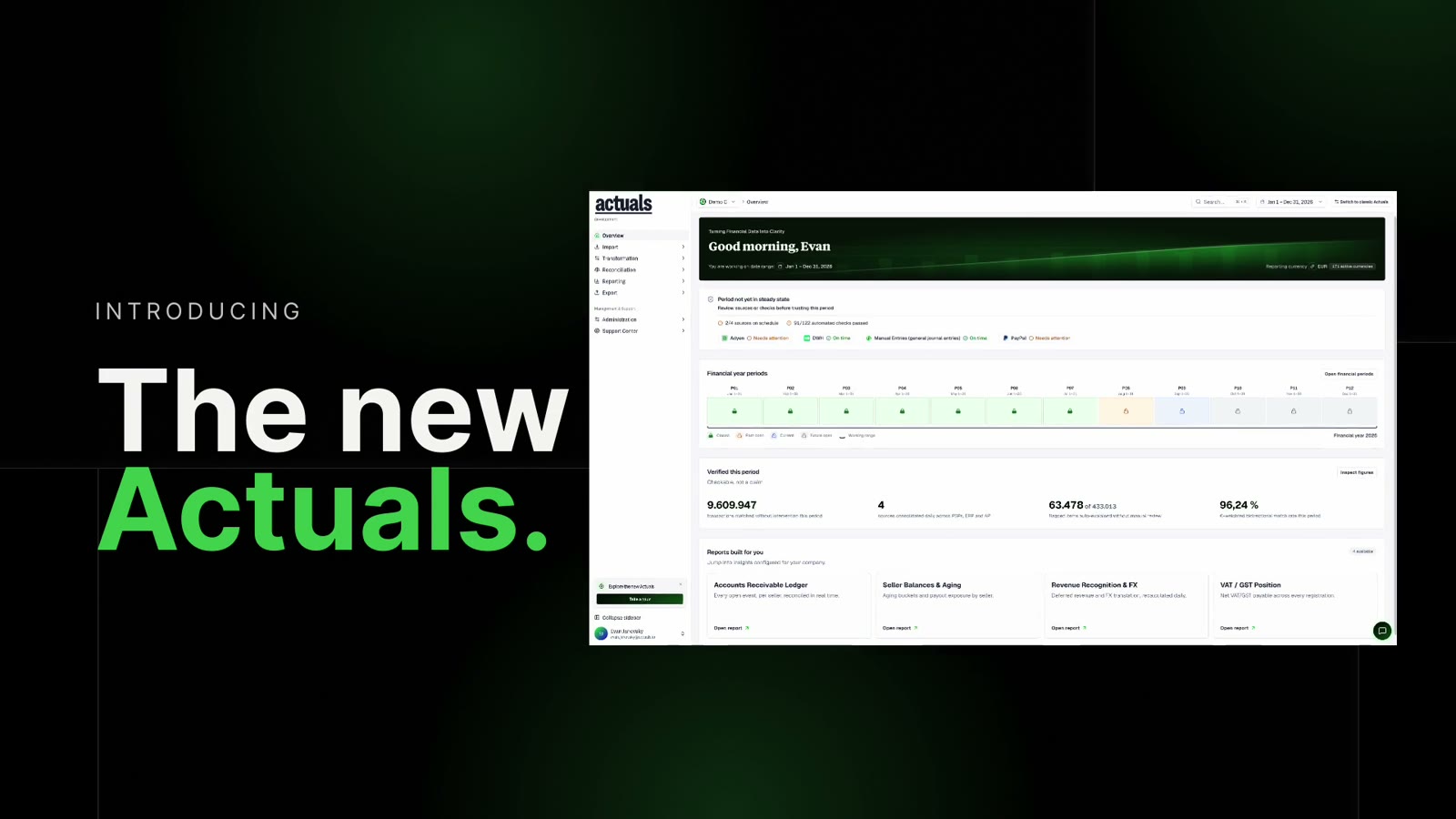
So the team talked a lot about what was missing and what just needed to work better. They really wanted to nail the first page of the new Actuals, and Peter showed it to the room. His wish: every user takes a screenshot of that page, shares it with everyone and is just as proud of it as the team.
The page starts with the question that comes before any report.
Especially with AI, it's possible to create a lot of reports, but can I actually trust the data?
That is why monitoring sits at the top. Did you receive all the files? Were there any errors? Did something happen that shouldn't have, for example with currencies? Did you process everything you should?
Below that, the page shows the value in numbers: what's connected and how many open items the platform solved automatically. Next come periods, which Peter called a very key concept. They line up with your month-end close and guarantee that the data in the platform no longer changes. Finally, there is direct access to the main reports, such as accounts receivable.
Helloprint: every invoice line against the order
Peter then introduced Helloprint, a company he said has become AI-native: it does most of its work with AI first in mind. That made it a perfect partner.
He handed the floor to Arturo Arpón, who works in finance at Helloprint. His slides, titled Building AI-Native Finance, show how Helloprint works with Actuals to reconcile purchase orders against invoiced amounts at scale.

Manual checks don't scale
Helloprint's problem slide is called Manual Reconciliation Doesn't Scale. The company handles more than a million order details a year, with 8-figure COGS and more than 200 active suppliers. Every supplier invoice is checked against the purchase order, line by line. Formats, currencies and references differ per supplier.
Peter had already set the scene: file formats that change every 3 weeks. How, he asked, do you keep from losing your mind with all of that?
Two lines on Helloprint's slide show what this costs. Errors and duplicate charges hide inside the noise. And the team spends hours every week on checks that should take minutes.
How the matching works
Helloprint's slide on where Actuals fits in shows 3 steps, from inbox to reconciled without the manual middle step. First, supplier invoices land. Then Actuals reads each invoice, pulls out the lines and matches every one to what Helloprint expected to pay. Finally, NetSuite records it: matched invoices post straight through, ready for review.
That last step fits what Peter said about the ERP. Actuals only wants to make the ERP more powerful, with everything you can do in it. For that, it has to be very clear, with nothing in between, that the data is what it should be.
What the matching found
Helloprint went through all of 2025 using Actuals' own filtering and dashboards. The results are on a slide called The Value Hiding in the Data:
- More than €500K in net overcharges identified at Helloprint.
- More than €200K recovered from suppliers.
- More than €300K corrected internally.
Ask instead of click
Helloprint's next slide, Ask Instead Of Click, shows 2 real queries from its own Actuals environment. The first is a matching overview: the same numbers as the Actuals dashboard, one question away. The second drills into exactly what didn't match, filtered to one category.
The final slide reads: This Is What AI-Native Finance Looks Like. And it's only getting faster. Helloprint's figures in this article come from those slides.
AI agents on the roadmap
Peter didn't present the new Actuals as finished.
Said at Finance Unlocked
This is not the finish line. This is for us the starting point.
Next on the list are specific journal entries with validations on top. They make sure what Actuals does lines up perfectly with what the ERP uses. Then matching updates with even more automation, so open items get solved as quickly as possible. And more native reports, to help you find the key answers you're looking for.
The fourth item is MCP, which had already come up in one way or another that day. It would let large language models or agents talk to the Actuals platform. Today, some users solve unclear and open items themselves. In future, Peter said, those could be agents. It is a roadmap item he is very excited about. Earlier that day, the room had already seen options in other tools, such as Databricks and NetSuite.
Actuals didn't wait for the roadmap. The team decided it could start already, and it did: it started work on an MCP integration, together with Arturo from Helloprint.
What to do on Monday
Each step below comes from the launch or from Helloprint's slides.
- Before hiring to keep up with volume, look for the symptoms Peter listed: slower closes, a growing pile of open items, and balances you wrote off without really wanting to.
- When there is a difference, find out what is in it. A late payout, partial refunds and a bank transfer entered by hand can all add up to the same total.
- Before you trust a report, run the checks the new Actuals home page starts with: did you receive all the files, were there any errors, did you process everything you should?
- Work in periods that line up with your month-end close, so the data in them no longer changes.
- Let software match every line of each supplier invoice to the purchase order, the way Helloprint does with Actuals, instead of checking line by line by hand.